August 6, 2014

Intro to the 1 Accord Project

(Images & logo will be uploaded later, but feel free to read on...)

About 5 months ago was the peak of activity for a new ministry that has been on my heart for about a year and a half.

The vision wasn't for another church. (There are enough churches. Couldn't we all agree?)

In fact, it's kind of unsettling within me when I hear the word church to describe either a church building or a ministry. In it's truest, biblical form the word "church" is best defined as the collection of every Christ-follower.

If you really wanted a strict definition from me, it would be this: the ONLY Christian church is the universal church. These groups of believers that make up what are commonly known as "churches" are simply part of the true church.

In my opinion, "churches" as we know them are fractions of the church or calling them ministry centers would be even more accurate.

Have I lost you yet?

Of course, I don't despise the usage of the word "church" in common venacular, I just think it is misleading and steers away from a much more beautiful idea.

And, I believe in my core, that the biblical idea of church has been, at worst, at worst and, at best, making a slow resurgence in the local culture of Elizabeth City, NC.

There are churches who are looking to reach outside the confines of their buildings. There are few others who are looking to partner with other churches in order to make a bigger impact.

In a nutshell, that is what I see the 1 Accord Project doing:

Partnering churches together for a deeper and wider impact in our city.

For most of you (outside of about 30-40 people), this may be the first time you've ever heard that Jenny and I were considering starting a ministry.

It would be what is known as a parachurch ministry, which is simply a ministry that works alongside of the church and is not a replacement for a faith community.

Speaking of such, there are over 100 churches in Elizabeth City. Few are large (say more than 200 people), many have less than 100 average attendees (some have 20-40).

There are more black churches than there are white churches. 

(And yes, just like Martin Luther King, Jr. said more than 40 years ago, Sunday is still the most segregated time in our city.Think about it. Have you ever been to a church more than once or twice of another racial makeup?)

There is a 1-square mile near downtown that has a whopping 20 churches!!

Here's the heart of the 1 Accord Project (in the form of questions):
  • What if churches worked together?
  • What if the Church (as defined  before) came together and combined their efforts, finances and prayer towards the same goals in EC?
  • What if these resources could be combined and sent to organizations like the food bank, homeless shelters, pregnancy centers, etc?
  • What if Christ-followers from all different churches volunteered together at those non-profits not as members of "so-and-so church" but as Christ-followers?
  • What if churches sent their people on mission trips with other churches for a greater world impact?
Doesn't that sound like the true ministry of the church?

One question that's been sitting in my spirit for a week is this:

How has the church made the simple but incorrect twist that the Great Commission ("Go into all the world and make disciples...") is all about having people (preferrably ones not connected to a church) "come and see" what's going on at your church from the true meaning of THE CHURCH "going, doing and telling?"

"SOUNDS GREAT! LET'S GO!!"

Hold tight. Most of us are not ready.

"WHAT DO YOU MEAN? GET 'EM TOGETHER AND LET'S GO!"

It is my firm belief that not only does the church not do enough in their local communities (and even less together with other churches), but that when they do go their people aren't ready anyway.

Let me give you an example.

I set up a simple outreach on the Outer Banks about a decade ago where our students from Asheville would hand out bottled water (that, of course, had scripture taped over the label) to anyone who wanted one on the beach.

Tracts are awkward. Scripture on a bottle of water is less awkward, right?

Although that may be true, one glaring fact remained after our "outreach."

Not one of us engaged in a meaningful conversation with a person that we gave a bottle to. We had some ask, "what church do y'all go to?" But, other than that, not much.

That's disappointing but, I should've counted myself relieved.

"Relieved?! Why?"

My students weren't ready.  They had a simple job that was carried out with a church t-shirt on. Anybody could've done it. But few of them were ready, as Peter says,

"Always be prepared to give an answer to everyone who asks you to give the reason for the hope that you have. But do this with gentleness and respect." (1 Peter 3:15)

When you do outreach you need to have your stories straight: God's story (what the Bible teaches us) and our story (how Christ has changed our lives).

As part of 1 Accord, I developed a 3-month seminar that teaches Christ-followers four basic things (or the 4 G's):
  1. The basics of the gospel and God's Word
  2. How to live a God-honoring lifestyle and why it's important
  3. How to craft your story and discover your unique gifts
  4. How to utilize those gifts in order to go, serve and share your faith
.
.
.
.
.
.
.
.
.

That gap in space represents the past 5 months since we have temporarily halted the launch of the 1 Accord Project.

Jenny and I are still searching for a church home and sincerely believe that within the confines of a thriving ministry is where 1 Accord belongs.

Also, we praying for Christ-followers to have the same burning desire that we have.

Who cares where people go to church? The most important thing is actually showing and sharing the power of Christ to our community, is it not?

That power is not displayed by a message, music or small groups, is it?

It is when the believers leave the church building and act as the CHURCH. Fully armed and ready to serve.

Church attendance has little to do with community impact if the people within a church building only bring people to church in order for the pastor or preacher to convince them to faith.

Mmm. I would love to see a diverse Church, with unlimited power (through God's Spirit) and burgeoning resources to come together for the good of EC, not the good of their church.

I'll leave you with this.

If Jesus Christ is the image of the invisible God, then what is the Church?

Are we not the image of the (now) invisible Jesus?

If that's true, how could we do ministry as a Church together differently so that everyone in our city knows that the Church is a powerful, graceful, merciful and generous entity just as the God they serve?

That's gets me going. I think about that every time I drive through Elizabeth City.

How about you?

January 17, 2014

Exodus 1: Mel Gibson, Lying and God's Ethics

After William Wallace is betrayed by his fellow Scotsmen Mornay and Lachlan on the battlefield of Falkirk against the British, he avenges their treachery by killing them in cold blood. Before the next battle, another nobleman named Craig, who had ties to Mornay and Lachlan is brought to Wallace.


When grilled by Wallace about his allegiance to King Longshanks of England, Craig responded by saying, "An oath to a liar is no oath at all."
 

That makes sense, I guess.

In another, less gorey Mel Gibson movie, Bret Maverick lounges in a hot tub. His father questions him about tricking the Commodore, one of the film's antagonist, in the final action scene of the movie. In a classic line, Bret replies, "My pappi always said, 'There's no more deeply moving religious experience than cheating a cheater."'

I love that line.

The implication I'm going to make on today's post will, most likely, be controversial to some of my more conservative friends but, at least, we can get a good laugh (or smile, if you're too serious).

I believe these two quotes are applicable to an obscure implication buried in Exodus 1:15-21.

Read it here, if you'd like.

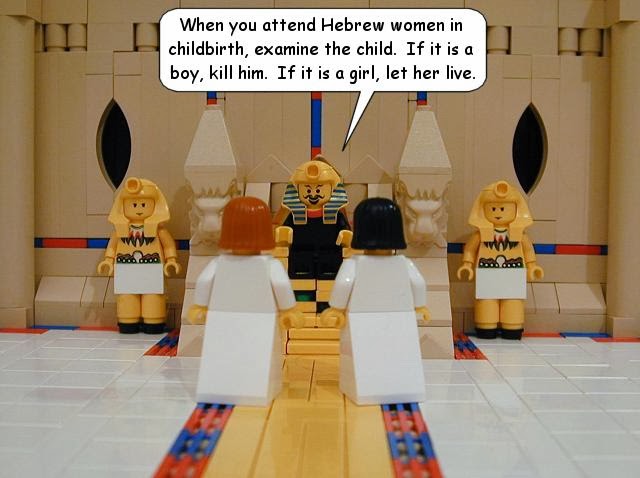
Jacob, Joseph and all of his brothers have died and there's a new pharaoh who not only doesn't care about their descendants but desires to suppress their growth by forcing them into slavery. When he sees that God's favor is still on the Israelites and that their population keeps growing, pharaoh commands something dispicable from his midwives.

Pharaoh commands: "When you are helping the Hebrew women during childbirth, if you see that the baby is a boy, kill him; but if it is a girl, let her live.” (verse 16)

I could completely twist Scripture and say that this is the first recorded instance of abortion, but how would midwives recognize the gender of a newborn without seeing it with their technological limitations, I'd like to know?

What pharaoh is commanding is more like infanticide (not much different than abortion, in my humble opinion), in the likes of Kermit Gosnell, who was found guilty of killing seven newborns last year. The midwives were supposed to sabotage the childbirth and assure that the newborn boys would die. 

How? The Bible isn't clear.

This post is not about abortion, however. I want to focus on what happens next.  The midwives, who feared God, decided to let the baby boys live. (verse 17) When interrogated by pharaoh as to why they disobeyed his orders, the midwives replied, "the boys were already born when we got there." (verses 18-19)

Did the midwives lie?


Yes. It's easy to deduce from the passage that the midwives were in position to fulfill pharaoh's orders but didn't because they were fearful of God.

Did God permit the midwives to lie in order to save baby's lives?

It seems so because God did not react negatively to their deception. In fact, God blessed them by "giving them families of their own." (verse 21)

Is God going against his own nature or is there another explanation as to why God allowed a sin to cover up a sin?

Explanation #1: God makes an exception, leaving the biblical laws as we know them much more fluid in their interpretations. Translation: God may ignore certain sins sometimes because they are not serious and/or do not cause obvious harm.

I don't believe that for a second.

Explanation #2: The Law of Moses, which includes the Ten Commandments, isn't given to the people of Israel until AFTER leaving Egypt in Exodus 20.  (Lying, or bearing false witness, etc, is the ninth commandment.) If the law had not be enacted yet, then could Israelites be held accountable for lying? If that's the case, then perhaps that's why it was permissible for Abraham to lie about Sarah being his sister and not his wife on two occasions. (Genesis 12 & 20)

Seems plausible, right?


Explanation #3: Conservative-leaning types, you may want to look away. Perhaps God is not limited to the Bible (the Bible is the Word of God but not the totality of God) and is able to intercede in certain circumstances in which the objective is to eliminate a common enemy at any cost. How else could Christ-followers ever partake in war, for example?

I realize that my explanations are very vague, but doesn't that lead you to question certain things?

Questions such as:

Does God permit sinful actions in certain situations when doing so would prevent a greater evil?

Now THAT is a can of worms that many many theologians have debated for decades.

The quintessential case of situational ethics is presented with the story of Dietrich Bonhoeffer. Bonhoeffer was a devoted Christ-follower and Lutheran pastor in Germany during the Nazi regime. Going against common Christian pacifism, he decided that assassinating Hitler (even though that would be a sin against God) was worth it to prevent further slaughter of the Jews. He eventually was imprisoned and killed by the Nazis. The battlefield for his soul in dealing with the decision to kill or to remain passive is evident in his letters from prison aptly titled, "Letters and Papers from Prison."

I know what some of you are thinking:

"Where do you draw the line?"

"If the Bible isn't clear on what sins are greater than others, how can we decide to do a lesser sin to prevent a greater sin?"

Fair questions, indeed.

As for the second question, I do believe the Bible gives an indication of what sins are more egregious to God than others. This will be a topic of a future post but if you'd like to read ahead, take a look at Ezekiel 8.

But for now, I'd like to know what you think on situational ethics? Apart from telling "white lies," what biblical justification have you found to support or utterly deny that God would allow a small sin to cover up another?

January 4, 2014

Genesis 22: Kill your son, Abraham!

In an account that is infuriating to some and confounding to all, Genesis 22:1-19 includes one of those stories that is hard to digest. Actually, it's tempting to make Abraham's resolve the object of adoration instead of focusing on God's request (even though it never came to pass).

My goal today is to present a few possibilities that are not explicitly expressed in the Scripture but, nevertheless, could give us a fuller and perhaps clearer picture of how Isaac, Abraham's treasured son, was nearly slaughtered by his father.

Read along with me, if you'd like.

It's clear from the get-go that Abraham is going to face a test from God. (verse 1) Tests and trials are to be expected in life. In fact, to some extent, I try to prepare for every possible negative circumstance. But, some things, you never expect to be a test.

I bet you Abraham never expected God to ask to sacrifice Isaac, for one thing. (verse 2)

Can you imagine the heavy burden that had to have hit Abraham when he received this request from...God? Scripture is silent as to Abraham's reaction but I could imagine him saying:

"Really?! Is this the same God that promised me that I would have a son and countless descendants? Could God really want me to not only end Isaac's life but leave me childless again just to wonder if I'll ever have another son? This ish is bananas b-a-n-a-n-a-s!" 

(Ok, he probably didn't say that last part.)

Me, personally? I wouldn't have been near as insightful.

I would've told God off. I have one child; a 9-month old girl. I wouldn't have even considered the possibility of doing such a thing. What about you?

(I say this because I know better. I have this Bible story right in front of me and know the outcome. Plus, I know of a certain cult practice of the Ancient Near East that is closely related to this story. This cult practice coupled with God's request doesn't make sense. But I'm getting ahead of myself. We'll touch on this just a little bit later.)


Abraham saddled up with Isaac and a couple of servants on a 3-day journey to the exact mountain on which God told him to sacrifice his son. He, obviously, kept his exact intentions from everyone else. Or was Abraham's statement of "we will worship and then WE will come back to you" (verse 5) a hopeful statement of faith? We'll never know for sure.

As they venture on alone, Isaac notices that something is missing. They had all the necessities for a burnt sacrifice minus the animal to be slaughtered. (verse 6-7)

Once again, Abraham gives a hopeful response in "God Himself will provide the lamb." (verse 8) Did he really believe that or was this, again, a deceptive answer? Both could be true.

They arrive, build the altar and Isaac is tied down. (verse 9)

Let's pause right here.

The majority of scholars seem to agree that Abraham simply overpowers his son and, by brute force, ties him down; Isaac is given no say in the matter.

A minority of scholars have offered two other possibilities that are definitely plausible.

Alternate scenario #1: Abraham reasoned with his young son; Isaac consents to his father's request

This scenario changes the whole vibe of the story. If this were true, then Isaac deserves a ton of credit of being willing to die at his father's request. (Sound familar? It should.) Either Isaac is completely devoted to God or to his father or both. You could also say that perhaps Isaac is also hopeful that God indeed will "provide the lamb" for the offering.

Alternate scenario #2: Abraham had no choice but to convince Isaac to consent to being sacrificed

(This one takes a little more explaining. Bear with me.)

Yes, this scenario is very similar to the previous one.  The sole difference is how we view Isaac. The word used for boy (in Hebrew na-ar, verse 5) can be used in some instances to mean "young man." In fact, the same word is used to describe the servants that accompanied Abraham and Isaac to the mountain. It's highly unlikely that the servants were little boys.

Also, would Isaac been able to hike up a mountain carrying enough firewood to consume a human body in flames by himself if he were a boy?

Again, unlikely.

In light of this evidence and other solid time-frame cues in the Bible, several scholars have estimated Isaac's age to be somewhere between 20-33 years old.  This would make Abraham's age somewhere between 120-133 years old. Abraham lived 175 years. So, by comparison to our normal life spans, Abraham would have been in the shape of a man in his fifties. Not a pushover for sure but wrestling a young man who is 20-30 years younger may be a losing cause.

(You can read more about this train of thought here)

If all this is true, again, Isaac is to be commended.

All this dissection goes for naught when God speaks from heaven and stops Abraham from stabbing his son. (verses 11-12) If you truly believe that God is omniscient (all-knowing) then you would know that Abraham was going to kill his son. Abraham couldn't have faked it.

Wow. You can call it lunacy or reckless faith, but wow.


Abraham looks up to see a ram whose horns were caught in a bush. (verse 13) Isaac is saved, God provided and the ram is the perfect substitute.

The test is over. Abraham (and Isaac) have shown themselves devoted to God. Let me ask you one last question before I conclude:

Did God ever intend for Abraham to actually go through with killing his son?

Interesting question, isn't it? I believe the answer is no.

"How could you possibly even assume to know that, TJ?" 

Ever heard of the ancient god Molech of Ammonites? He's in the Bible; 16 times, in fact. He is described as "detestable" in 1 Kings 11.

"What about Molech was so bad that he, out of all the other gods in biblical history, deserved to be called out in such a way?"

Molech required one thing from all of his followers:

The sacrifice of their firstborn child!


The God of Abraham denounces this practice adamantly! All life belongs to the LORD, not to some false, pagan god. (Lev 18:21) If children were to die due to this practice, the God's law demanded that the parents be executed in response. (Lev 20:2)

Isn't it safe to assume that if God speaks so strongly against child sacrifice in the Bible that He was only "testing" Abraham, not intending to force him to kill Isaac? Also, if God could kill all the firstborn sons of Egypt on one night in one fell swoop (Ex 12), then why would He ever ask one human being, much less a father, to do it for Him?

God knows what it takes to lose a son

Still, Abraham is more faithful than I would've been.  But, like I said, knowing the whole Bible story, this account comes into focus. Again, this account foreshadows what God eventually would do for us. God is to be praised for providing the "sacrificial lamb" in Jesus Christ for us all. Jesus, like Isaac, should be commended for obeying His father regardless of what He would have to endure on our behalf.


You see, that's the difference between us and God. God would give anything, even His own son, to have us love Him.

Us?

Well, it depends on what He asks from us, doesn't it?

Please know that God would never ask you to go against His commandments to prove your love for Him. He's a big boy; He can do His own work. However, to show your devotion, all it takes is humility, repentance, faith and following Jesus.

If you have children, go love on them right now!

If you don't, be thankful that your parents aren't Molech-worshippers:)

January 3, 2014

Genesis 15: God wouldn't kill Himself, would He?

You'll see that I'm not working on a thorough, chapter-by-chapter discourse through the Old Testament. For example, I skipped Genesis 11 and the account of the Tower of Babel. It definitely is an interesting story, you should check it out. It may be the reason and explanation as to why we have so many varying languages and cultures that developed in our world.

But the task at hand for today is delving into Genesis 15 and a rather peculiar interaction between Abram (later to be renamed Abraham, the father of the Jewish race) and God. The chapter begins with two reminders. God reassuring Abram that he is treasured and loved (verse 1) and Abram reminding God that his greatest desire (to have an heir) has yet to be fulfilled. (verse 2) In fact, if his life were to end on that day, his estate would be given to a servant who isn't even part of his family. (verse 3)

This is the first (yet not the last) time that God directs Abram to try to count the stars in comparison to the amount of descendants that he will one day have. I love how NASA agrees that counting all the stars in a night sky is impossible (See for yourself). Other websites suggest that there are somewhere between 5,000-10,000 stars that can be seen with the naked eye. However, you must consider that the patch of sky that we see on a starry night is NOT the whole sky. We are only seeing one patch of sky that is visible from our vantage point on earth, so the total number of stars in the sky that could be seen with the naked eye is astronomically (pun intended) greater than just 5-10k!

No doubt, what God promised has come to pass since there are just over 13.7 million Jews as of 2012. Fun side fact: Did you know that nearly 40% of all Jews live in the USA? (Source: Jewish Virtual Library)

Ok, let's get back on track here.

As if Abram believing God wasn't wild enough, the latter half of verse 6 should arouse your attention. Due to his belief that God was worthy of trust, God counted Abram as righteous. In our southern, Bible belt vernacular the equivalent would be, "he just got saved!" Paul, the writer of more than half of the New Testament mentions this phenomena of God's grace in his letter to the Romans (chapter 4, to be exact) to prove that its grace by faith in which God saves us, not in response to any physical act, good deed or lifestyle.


God promises something further. Abram would receive the land they were standing on as his own. (verse 7) Ironically, after believing God could give him innumerable descendants, he seems to doubt the possibility of owning this land; something seemingly much more plausible, in my opinion.

Yet, instead of ridiculing Abram, God did something amazing. I've said everything above to get you to this point. This blew my mind once I realized the implications of what happened next.

God instructed Abram to gather a few animals and a couple of birds, to cut them in half and lay the sides opposite one another to make an aisle in which to walk in between the halves. (verse 10)

Such as this:

                             Enter

          1/2 calf                       1/2 calf
          1/2 goat                      1/2 goat
          1/2 ram                       1/2 ram
          Dove                           Pigeon

                              Exit

After Abram shooed away scavengers for a while, he fell asleep (verses 11-12). This is the cool part, because the set-up for this ritual was, let's just say, weird. For some reason, God decides to reveal Himself as a "smoking firepot with a blazing torch." (verse 17)

Why a firepot and torch? 

No one knows for sure but one could reasonably assume that this could be a foreshadow to how God would reveal Himself in the wilderness as He leads the Israelites; as a cloud during the day (similar to a "smoking" firepot) and pillar of fire by night (compared to a torch which lights a footpath) as seen in Exodus 12:21-22. It seems to fit perfectly.

That's cool but I haven't gotten to the coolest part yet.

To truly grasp the magnitude of what God did here, you have to understand what this little ceremony or covenant display meant. In ancient Mesopotamian culture, it was customary to perform this ritual as a way to bind individuals into a lasting covenant. If one party were to break this covenant, they were giving the other party permission to cut them in half and experience the brutality of these particular animals.

That's some raw stuff, eh?

"So, what?"

Let me ask you question that will commence the blowing of your mind:

Who walked down the aisle and participated in this covenant?

"Abram and God, right?"

WRONG!

God alone walked between the animals. Check the text! In verse 17 God passed between the animals and, in verse 18, Scripture reads "the LORD made a covenant with Abram."

The text does not read they entered into a covenant, it says that God alone made the covenant.

God is promising Abram and God alone is the only one that would face punishment if He failed.

I can hear some people saying, "TJ, that doesn't make any sense. How can you kill God, especially if He's invisible and immortal?"

Fair question. (Are some of you starting to follow along?)

God wouldn't kill Himself, would He?

Let me ask you a slightly different question that may clue you in on my dropping of hints:

How could God die?

If we couldn't do it, would He kill himself?

"That's impossible! The Bible is against suicide, isn't it?"

While most Christ-followers believe that suicide is utterly sinful and disrespectful to God it isn't directly prohibited in Scripture (at least that I know of).

Its not a coincidence that Abram's salvation was mentioned just a few verses prior to God committing to this covenant. If we fast-forwarded through the historical narrative of the Bible, the story of God wooing His creation to Himself, then we would see that Jesus, indeed, went on a suicide mission for our salvation. God in the flesh subjected Himself to that, once thought impossibility, of dying.

And that Jesus did.

For us. Not just for the Jews but for everyone else, too.

Even though humanity deserved the punishment of straying from God and sinning against Him, there was no way that humanity dying was an option since Abraham was not part of this covenant.  

)Yes, I do know that the Israelites would later covenant with God after the creation of the Mosaic Law in Exodus but it wasn't this type of do-or-die, cut-throat covenant in Genesis 15.)

To me, this obscure, mostly ignored story provides a glimpse into the reckless love that God has for humanity. Have you experienced the lengths, depths and measure of God's love? If you haven't, the life of Jesus is the full-expression of God's intent to commit to His end of the bargain, which was completely unfair for Him to even have to uphold in the first place.

The Israelites eventually inherited the Promised Land (only to lose it) and all of humanity now has the chance of a relationship with the Creator, but in doing so, Jesus had to die.

Let me leave you with two Scripture verses that may let this sink in better than I could ever say:


But God showed his great love for us by sending Christ to die for us while we were still sinners.
- Romans 5:8 

Though he (Jesus) was God, he did not think of equality with God as something to cling to. 
Instead, he gave up his divine privileges;  
He took the humble position of a slave and was born as a human being.
When he appeared in human form, 
He humbled himself in obedience to God and died a criminal’s death on a cross.
 - Philippians 2:6-8

As always, I'd love your thoughts. 

January 2, 2014

Genesis 3: Vegans & Gender Equality

My desire to be in God's word more than ever is not just a resolution for the New Year but something I need to become a better father, husband, pastor and leader.

Speaking of being a pastor, one of the things I really have to focus on is being succinct. If you've ever had a conversation with me, you'd know that I talk a lot. I share a lot of information; pretty much whatever interests me or has recently blew my mind. Ask my wife how many times a day I start a conversation with, "I was reading this article/watching this documentary/this video and..."

With that being said, I'm in the process of a going through a reading plan through my Glo Bible (an app on my iPhone). In the spirit of CDM (Constantly Dodging Monotony), I wanted to share a few insights I've noticed in my readings that may inspire you or, perhaps, get you interested in delving into the Bible for yourself.

Vegans and Gender Equality

The earth and everything in it has been created. God claims everything to be "good" but when he finishes creating Adam, creation in its totality becomes "very good." (Gen 1:31) This is the first way to tell that humanity is the prized "jewel of creation" as it has been said.

Have you ever noticed the implication of Genesis 1:30, though? Animals (birds AND beasts) solely eat vegetation. The next day, when Adam is created, he is given the same diet.  Can you imagine a world where one could safely walk through the jungle or deep wilderness without any fear of being mauled by a wild animal? That's what Adam had. No doubt, lions and lambs grazed on the same patches of land without disruption. (Seeing slow motion footage of a gazelle being eaten alive by a lion or hyenas has always been disheartening for me.) Buzzards and other scavengers of today ate the same, too, since there wasn't any decomposing carcasses to devour.

Adam would be a vegan. Here's an interesting question: Did God initially create humans to be vegans? It makes me wonder if the body was designed to run at its most efficient state when it only had water, fruits and vegetables. He also had access to fruit juices and maybe even coconut juice. It seems logical, right?

I'm not implying that eating meat is sinful. However, in a perfect world not one living thing would have to die in order to be food for another. It wouldn't be a stretch to assume that heaven's diet may revert back to this perfect-state standard, right? Pardon me, while I go eat a banana.

Let's talk about something else that, no doubt, was different before the presence of sin and will be in heaven, as well.

I know that many of you have read the account of Eve being deceived by the serpent, but I want to challenge you to consider something else the passage may suggest.

Look at Genesis 3 yourself. (Follow along here)

Is Eve alone when she's talking with the serpent or eating from the tree? (Look at verse 6, the last line) Adam is there! Adam is, from what we can tell, completely complicit, silent and not offering any suggestions or accountability.

Eve is the one talking, the one who is deceived, tempted and decides to go against God's command.

Adam's sin was slightly different. Even though he may have been deceived, tempted and, obviously, did eat from the restricted tree,

Adam was guilty of being spineless.

He seemed to be in the perfect position to protect his wife (not to mention humanity, animals and all of the earth in the process) but he didn't. Was Eve determined? Did she coerce Adam to go along with the deception? Possibly, even though that amount of detail is not present in Genesis 3.

What is clear and unmistakeable is Adam's silence.  He does nothing but add to the debacle by not holding his wife accountable and stopping her.

Afterward eating the forbidden fruit, the first thing Adam and Eve notice is their nakedness. (3:7) They immediately seek privacy; don't confuse that with modesty. The first barrier between a married couple after sin was inherently a sexual barrier. Married men, you know what I'm talking about, right? It's still the first barrier we encounter when there's an issue with our wives.

That makes me laugh:) LOL! (And yes, I literally did laugh out loud.)

After a round of everyone passing the blame (Adam to Eve to the serpent in 3:12-13), I want you to notice what Eve was cursed with as punishment. I'm sure there's an interesting insight to be told as to why childbirth was made super-painful but the one I'm curious about is the next curse, which flies under the radar and can be easily missed. In the second part of Genesis 3:16, God told Eve,

"Your desire will be for your husband, and he will rule over you."

This is in stark contrast to what we saw at the trunk of the tree of the knowledge of good and evil, right? Eve seemed to be in control of the conversation and decision-making when it came between her and Adam. It was her decision coupled with Adam's inaction and collaboration that caused this mess.

(Jesus is, by the way, the solution to this problem. His death on the cross and resurrection is the payment for humanity's sin. If we first accept and believe that and then live by His words and commands, we can start to experience the life God truly means for us to have.)

The beginning of the end of humanity's perfection began with Adam's lack of influence on his wife. He was not only accountable for the garden and all the animals but also his wife and HE FAILED!

Most people blame Eve, letting Adam get off the hook too lightly. So God forces Adam's hand and curses Eve in the process.
Men were now to "rule over" their wives. No doubt this is the beginning of what is well-known as a male-dominated family structure and culture that began in the Middle East and is still prevalent in America. In Latin America it is known as machismo. But instead of leadership, cultures have abused this role to make the livelihoods of the female gender to be even more cursed.

To this day, women are paid less to work the same jobs, are the majority of the victims of domestic violence in the home, are raped and sexually assaulted almost exclusively, are labeled as "feminists" if they demand equal rights and the list goes on and on.

Don't get the Bible twisted. I believe God is forcing Adam to lead and provide accountability to his wife, to protect, serve and rule the relationship not to victimize the female gender.

Let's ask this question in response, "What does a perfect situation, void of sin, look like then?"

It is my humble belief that in a perfect society, as it will be one day in heaven, males and females again would be equals. Respect, accountability, influence and leadership would flow both ways. The possibility of abusing this role would diminish with gender equality, since the female is also a "jewel of creation."

(And c'mon men, you can agree that women are more apt to be praised as a jewel because of their beauty. Men aren't that pretty.)

The creation story does inspire me to worship God as the ultimate Creator of all things, but after reading through it again this week, I've also learned to consider my diet (which is full of meat, cheese and junk food) and my on-going relationship with my wife.  Providing accountability isn't necessarily my weakness but I can always be challenged to value my wife's (and any female's) opinion just as valid as I consider my own.  Abusing influence is worsening the curse.  Let's flip that, shall we?

Thanks for coming along! Would love your questions, comments, thoughts and even accountability!

Update:
A friend of a friend posted Isaiah 25:6 in response to my blog, which says (speaking of the future):

"On this mountain the Lord Almighty will prepare
a feast of rich food for all peoples,
a banquet of aged wine—
the best of meats and the finest of wines."

Him and I both agree that if God created everything we know, then isn't it possible for him to create meat without slaughter? Sure. Or it will be the best tasting, textured tofu you've ever had!

April 7, 2012

Day 68 - Romans 9

In this chapter Paul talks even more about the true character of people and even how God creates people's dispositions.  You'll be surprised to see how Paul describes the two types of people in the world that God created.

Read with me...

Romans 9 (Read it here)

Paul is certain that non-Christian Jews wouldn't likely agree with what he's said thus far.  The Jewish nation was built on the law of Moses and now Paul says that faith in Jesus is more important. In fact, doing all the good deeds in the world won't please God if faith isn't involved.  By the way, this would offend people of many other philosophical positions, as well, not only Jews.

Paul assures the church in Rome that his truthful words are being guided by the Spirit. (v. 1) It breaks his heart that Jews can't separate themselves from the law to find the freedom in following Christ.  He even wishes that he could trade his salvation in order for the Jewish people to fully trust in Christ. (vs. 2-3)  To him, it is sad to think that the nation that was created and founded by God himself, the people who received all His prophecies and promises, would ultimately be left behind. (v. 4) If anyone were to know what God was doing through Jesus, it should've been the Israelites!

The fathers of the faith (Abraham, Isaac and Jacob) are all precursors to the ultimate Israelite, Jesus. Here, in the latter part of verse 5, Paul makes no mistake in saying that Jesus is God; the ruler over everything and worthy of worship!

Since mentioning the human founder of the Israelite nation, Abraham, it was worth it to Paul to note an important distinction.  Just because someone is a descendant of Abraham doesn't make that person a child of God! Only children of the promise (per the original Greek, the ones who God approves and deemed right) are considered to be God's children (v. 8) Jesus says something very similar to this in Luke 3:8.

What does this have to do with us in 21st century America? One glaring point should be clear.  We do not inherit faith from a religious or church upbringing.  If your parents are Christ-followers, you are not automatically lumped in with them by God until you yourself come to faith in Jesus. Faith and salvation are not assumed, they are sought after and contemplated carefully.

Abraham's son, Isaac, had another interesting set of immediate ancestors (we'll call them sons). Before the twins were born, Rebekah (Isaac's wife) was told by God that he was choosing the younger son, Jacob, to carry on the promise. (vs. 10-11, 13)  God made His choice even before either son did anything right or wrong.  Even though Jacob would have the terrible habit of deception, God still used him to grow the Israelite nation.  Like Paul says, it really had nothing to do with one son being a better person than the other. (v. 12)

At first glance this does seem unfair, doesn't it?  How could God predestine the older son to serve the younger? But do we know that? Perhaps God simply knew ahead of time that Esau would be so foolish as to give away his inheritance just for a bowl of soup! (Genesis 25:27-34)

Either way, we are not God.  We don't know God's thoughts. Heck, we don't even know other people's thoughts. Who are we to judge? God can do what He wants; it ain't like any human being can stop Him!  He can choose, show mercy and compassion to whomever He wants! (v. 15) We can't even earn God's mercy. (v. 16)


Now God used Pharaoh in a completely different way. God made an example of out Pharaoh, the king of Egypt and probably the most powerful man in the world at that time. (v. 17) For even Pharaoh, with all his power, was powerless in opposition to God. God exploited Pharaoh's arrogance and made him ignore Moses' warnings. (v. 18)

Is God is running around voiding people's free will? Paul asks, “Why does God blame people for not responding? Haven’t they simply done what he makes them do?” (v. 19) Again, how can we, the beings God created, question the Creator? (v. 20) Some of us are like vases, we hold and display beauty. Others are like trash cans, they seem to hold garbage. (v. 21) Even if Paul says this, does that mean that God creates the garbage (or evil) that people hold inside? Haven't we been talking about how humanity is naturally sinful? We don't need God to create evil for us to do, we instinctively do it. We are naturally hostile towards God. (Romans 8:7)

And, of course, God is patient with those who exhibit garbage can-like behavior; who have nothing but negativity, hatred and selfishness in them and are on the path of destruction (v. 22; both in destroying their own lives and in the symbolism of hell). There is a night and day difference between being in opposition to God and being one who accepts His mercy; there really is no comparison. Even though they both receive God's blessing of being created, those who accept His mercy will shine even brighter. (v. 23)

Even though God had created some as "vases" and others as "trash cans," that doesn't mean He can't change a person's destiny. Paul refers to the prophecy of Hosea that has been fulfilled. Hosea, speaking on God's behalf, said, “Those who were not my people, I will now call my people. And I will love those whom I did not love before." People who weren't considered His children will be called the children of the living God. (vs. 25-26) Does this not produce hope for any and all people? God truly can change any heart and does love every single person He has created.

In fact, many of the ones God created for a great purpose, namely the Israelites, will end up not being saved. (v. 27) Its not because He decided He didn't love them anymore.  Paul has been telling us the answer; the Jews just don't believe in Jesus, God's true path to faith and salvation. Actually, if God wouldn't have provided this way (through Jesus), all civilizations would share the fate of Sodom and Gomorrah. (v. 29)

Even those who never believed can be made right with God now through faith in Jesus. (v. 30) And, on the other hand, those who tried to earn God's love will never succeed without faith. (v. 31) Being a good person, even if its by God's law, has nothing to do with trusting and loving God. The law cannot be one's "god." (v. 32)

God knew this would happen, too. The prophet Isaiah referred to the law as a stone that people will stumble on and fall. It is right for a person to take note of the law and, of course, rectify what it points out. However, it should not be transformed into an idol; for even the law was God's creation.  However, faith in Jesus, who is worthy of worship gives God glory! (v. 33)


Questions


1.) Why do you think that the statement, "you cannot please God without faith" offends so many people? How does it make you feel?


2.) Paul says that God makes some people to be like vases and others like garbage receptors. How does this make you feel? Either way, would you agree with the fact that no matter how a person is created that there's always an opportunity for a person to change is great news? If you had to pick, how do you think you were created; as a bastion of beauty or did you receive a bunch of trash?


3.) Do you think it is ironic for someone to make an idol out of God's law? How common do you think that is? Do you believe that many Christians have more faith in the law (or the rules) than they do in Jesus himself? How does empty faith like that hurt others?

April 5, 2012

Day 67 - Romans 8

Its been a good week off. It was needed.  However, its been difficult to get back in the swing of things.  Nevertheless, there's not a better place in the Bible to get a recharge than from the contents of Romans 8.  Its one of my favorite passages because it is so encouraging.


If you're not encouraged then either you're not a Christ-follower or not paying attention to Paul's words!


Read and digest them with me!

Romans 8 (Read it here)

There is nothing more true and comforting for a Christ-follower to know than about the truth in verse 1. We are not condemned by God, regardless of what we think of ourselves when we accept and follow His son, Jesus.  God's gift of the Spirit to every believer gives each of us the freedom to thwart temptations to sin. (v. 2) The law doesn't do that. If anything, the law shows us how weak and sinful we are.  No human had the chance of living of a perfect life with sin being in control of our lives. So what did God do? He sent His son in human form, in our likeness, to live a sinless life. Jesus offered himself as a sacrifice on our behalf, because we couldn't be like him ourselves. (v. 3)

Did you catch that or have you heard it so many times you read right over it without thinking about what it means?  Jesus chose to LEAVE heaven, come to earth, be born in a horse trough, to be ridiculed, beaten and crucified so that all humans (even the ones who hate him) may have the opportunity to be reconciled with God.  Jesus chose to be born of a human and live a perfect life so he could die on our behalf (when we, humanity, were the ones who actually deserved death).

Jesus' sinless life is crucial because he is the only human (although being God's son, as well) that has fulfilled the law! Through faith in Jesus, we take part in his righteousness and live by the same power that guided him, if we are willing to let the Spirit take control of us. (v. 4)

How do you know if the Spirit has control over you?  Its quite simple.  What are the things you think about? Are those thoughts driven by selfish ambition (what you want or don't have) or hate (how you can't stand so-and-so)? If so, that's not a good sign, obviously.  If you are controlled by the Spirit, you will instinctively do what is pleasing to God. (v. 5) By the way, that hit me square in the gut because my thoughts are, half of the time, not pleasant or encouraging.

For example, while on vacation in Orlando, I let my wife inside my "real self."  We are both people-watchers.  When we go to a mall, for instance, there is little that evades our roaming eyes.  Jenny honestly told me she has a problem with anger towards women who are skinnier than her.  I told her that if not thinking about it, I could mentally think of something to pick on for every person I see.  He's overweight, "where's the rest of her shorts," they can't speak English, he looks like a dork and so on.


I only tell you this for two reasons: 1) This is who we are WITHOUT God. This is what we're naturally like without the Spirit guiding us. The Spirit kicked in when we finally discovered that we were mentally judging almost everyone we saw, even though we would never actually treat someone that way outwardly. What hypocrisy, right? 2) God hears every single word of it! When we belittle others, grumble or say anything else under our breath that isn't encouraging or directed at God, I call them empty prayers. Face it, if no one else hears it, who does? God does.


Letting that kind of behavior control you will lead to death. Not just physical death (duh, because everyone will die someday) but we're talking about remaining in a state of spiritual death. Where God is not present or welcomed, death is the master. It is there that no one else matters but the self.  A lifestyle of "I gotta get mine" might as well say, "God you gotta get gone." Only when we let the Spirit guide our thoughts and actions do we find peace and what life is really all about. (v. 6)

The way I described myself without God is common to all of us at some point.  In fact, Paul says that human nature is predisposed to being hostile to God. We naturally want to do what is opposite of what God would desire us to do. (v. 7) The aspect of surrendering our old selves is paramount because when we are in complete control of our lives (thoughts, actions and desires), it is impossible to please God.  For we only know what God desires when we give God control. (v. 8) That is why it is said, "without faith, it is impossible to please God." (Hebrews 11:6)

Even though Christ-followers may still have bouts with their old selves, they are not controlled by it.  God is the master of your spirit; Christ-followers belong to Him. (v. 9) With God, Christ, the Spirit (they're all the same) living within, the dead spirit in you comes alive! (v. 10) The same Spirit who raised Jesus is what's driving those who follow Jesus. (v. 11)


With that kind of power at our disposal, we have the ability to thwart any sinful temptation that is thrown at us. (v. 12) The more we ignore our selfish desires, the more we live. The more ignore where God leads, the more we die on the inside. (v. 13) 

Even though every human being was created by God, only those who follow His Spirit get the distinction of being called his child. (v. 14) You'll know it when you are a son or daughter of God, no one has to tell you. (v. 16)


If you have received Christ and have noticed a change in the way you see others and the world, you should be confident, not fearful. Your Heavenly Father didn't create you to be fearful slaves. (v. 15)  He created us to be heirs. We will share in God's glory, but also in his suffering.  (v. 17) For even though Jesus has been raised to a position of honor beside God in heaven (as Christ-followers will be, too, one day), he also faced persecution for his faith. Christians inherit both from Jesus. So if my life is rosy, without any problems, I need to wonder if I'm truly living like Jesus. Persecution is a prerequisite.


This life and the pain and struggles we have in it will be nothing compared to the glory God will reveal after we leave this earth! (v. 18)  One day everyone on earth will truly know who exactly are God's children and who are the posers. (v. 19) Even though Adam & Eve's sin brought about the curse of death, the whole creation (not just humans, but everything!) eagerly awaits the day when God will destroy death and decay. (vs. 20-21) Even the earth itself is wanting God to return for it, too, groans with pain and wants to be renewed. (v. 22)


Just think about that. All the earthquakes, tsunamis, hurricanes, tornadoes are part of the earth itself bringing about death. God did not create the earth to be this way.  The sin of humanity not only brought about a curse on the earth in the garden of Eden but also humanity continues to do so today (global warming, anyone?).  So just as sin can have control over a person, it can definitely have control over the earth, as well.  

Have you ever thought of it that way?


One of the greatest things we will inherit from God when we reach heaven is the inability to sin and suffer. This is made possible because God will give us new, flawless bodies. (v. 23) Too bad Paul doesn't have insight on exactly what that will look like. This promise is money, you can take it to the bank, (v. 24) its just a matter of time. (v. 25)


--------------------


Paul switches gears a little here when he references prayer starting in verse 26. Did you know that there are things that God wants people to pray for? Of course, we can't know the entire mind of God so the Holy Spirit prays for us! How wild is that?!


God can have this dynamic at work because he knows everyone's heart and thoughts. He and the Holy Spirit communicate flawlessly, unlike the connection between humanity and God.  The Spirit only prays for God's will to occur in our lives. Sorry, the Spirit is, most likely, not praying for you to get perfect traffic on the way to work.

Verse 28 is one of the most cosmic-sized, one-liners that Paul is famous for.  Its nearly impossible to wrap your mind around it (ok it may be impossible, actually). Paul says, "everything that happens in this world works together for good." If we stop there, we have a problem.  Obviously, there are plenty of people in this world that are models for life being cruel or unfair.  Does a Christ-follower just have better luck or does God make everything in our lives run smooth? Of course not! This is where this verse can cause more harm than good.

You have to remember that God is not partial; He loves everyone.  The reason why everything ends up "all good" for Christ-followers is that God gives them the peace to withstand it.  The average person can be destroyed by tragedy, but not a child of God. They are reinforced by His Spirit to not only survive suffering, pain and tragedy but also thrive in response to it!


All those who have come to faith in Jesus have not come by accident. God knew it would happen. He destines all believers to become like Jesus; to be recognized as righteous in His sight. He, again, will impart His glory both now and later. (vs. 29-30) In other words, we will have the ability not only to enjoy heaven but also the ability to bring a slice of heaven to earth by our actions and words.


Yeah, right

If you're like me, you don't bring heavenly feelings with all your actions and words.  Many times we have an opportunity to do something great, something gracious for someone in need and we blow it. That doesn't mean that God turns His back on us. (v. 31)


Since God was willing to spare even his own Son for us all, He will definitely give us everything else we need. (v. 32)  We'll need confidence, zeal, forgiveness, grace, persistence, peace and a million other things that would make this post a mile long.


If anyone ever judges you or calls you unworthy of being a child of God, you can say what Paul says, "How dare you?" (v. 33) As if anyone could know who God has and hasn't chosen to be right with Him. In that way, no one has the ability to condemn but God.  However, God will not condemn His children who have come to faith in His Son, Jesus Christ! (v. 1) Jesus, along with the Holy Spirit, also prays for us, by the way! (v. 34)


So what are we supposed to think if we run into a really rough patch in our lives?  What if we lost most of our valuable possessions in, say, a natural disaster? Does that mean God is judging us? 


NO!


Again, God doesn't condemn those that follow Him!  Nothing that we do, say or think can EVER separate us from the love of God! (v. 35)  This is where the phrase, "No matter what we do, God will not love us any more or any less" gets its reference.

Millions of Christians in other countries face persecution or even death for their faith in Jesus, yet still don't blame God for any calamity! Why should they? God's word promises that He doesn't condemn them, EVER! Victory, in this life and the next is ours because of Jesus has done for us! (v. 37)

Again, NOTHING can EVER separate us from God's love! Not death, nor demons, nor fear, not even hell itself can separate us from God's love! (v. 38) There is nothing that supersedes God's authority and nothing that trumps His love, especially nothing within us! So be encouraged, lift your head and live like you can't fail because its the truth! 


Questions

1.) Have you ever thought about the fact that Jesus chose to leave heaven to die for sinful humanity? He had it all in heaven with God, the Father, but his love for us drove him to earth to show exactly how deep his love is! Many people choose not to worship God because they don't want to worship a god that would force his son to die.  This isn't true, Jesus accepted God's will. He could've refused.  What does that say about Jesus' love for us that, even when he could've refused with no repercussions, he chose to die for our sins?

2.) Did you know that both the Spirit and Jesus pray for Christ-followers constantly?  Did you know there are things that God desires for each one of us to pray for?  What do you think God would want you to be praying for (globally, in your community, school and personally)?

3.) Do you believe that humanity's sin affects everything so much as to have the earth bring about death, too, in the way of natural disasters? Why or why not?

BONUS QUESTION: If you are a Christ-follower, do you honestly believe that there is nothing you can do to earn or lose God's love for you? Does your life prove or cast shadow on that fact? Why or why not?